Indian Mygalomorphs
A blue-sheened Haploclastus devamatha tarantula at the mouth of its burrow in red laterite soil, among tree roots
Haploclastus devamatha at its burrow · Kulathupuzha, Kollam district · 8°54′N 77°03′E
Tarantulas & trapdoor spiders of India · since 2012

The hidden giants of the Western Ghats

Mygalomorphs are India's oldest spider lineage: tarantulas that dig burrows, trapdoor spiders that build hinged lids, and tree tarantulas patterned like lace. This site shares two decades of fieldwork from Kerala's forests, for anyone who has ever wondered what lives in that hole in the bank.

11genera
5families
16species & populations
20+forest sites, 2003–23
Start here

What is a mygalomorph?

Spiders split into two great groups about 300 million years ago. Most of the spiders in your house are araneomorphs. Mygalomorphs kept the older body plan: heavy, long-lived, and almost always living in one spot for life.

25+

years of life

Females keep moulting even as adults and can live for decades. The record holder, an Australian trapdoor spider, reached 43.

0

ballooning flights

Baby araneomorphs drift away on silk threads. Mygalomorphs walk. A female may spend her whole life within a few metres of where she hatched.

10–15

burrows in 10 m²

Where the soil is right, a single road-cut bank in Kerala can hold a small colony of tarantula burrows, each lined with silk.

No

recorded human deaths

Even the most venomous Indian tree tarantulas cause painful bites and cramps, but none has ever killed a person in the medical literature.

A brown burrowing tarantula at the mouth of its burrow, legs spread and the eye mound and heavy jaws facing the camera
A burrowing tarantula at its burrow mouth, Kerala. The fangs fold under the heavy jaws below the eyes.
The one-glance test

Watch the fangs

A mygalomorph's fangs point straight down and strike in parallel, like a pair of pickaxes. An araneomorph's fangs swing towards each other like pincers.

The word "tarantula" itself is borrowed. It comes from Taranto in Italy and first meant a wolf spider, an araneomorph, blamed for a dancing frenzy.

Field cards · 11 genera from Kerala

Meet the genera

Each card starts with the story. Switch to Researcher mode, or open Specimen data on any card, for diagnosis, Kerala species, status and key papers. Tap a photo to see more.

From the field · 2014

Watch them at home

Short clips filmed during the UGC-funded survey of Kerala's theraphosid spiders. They play muted; tap to pause.

Coaxing out a blue tarantulaA researcher gently draws Haploclastus out of its silk-lined burrow in a laterite bank with blunt forceps, for photographing and measurement. Kollam district.
Dinner is a grasshopperHaploclastus devamatha in the lab, approaching live prey. Tarantulas hunt by touch and vibration rather than sight.
A burrow dressed in leavesThe entrance of a Haploclastus burrow at Agasthyamala, rimmed with dry leaves stitched in silk. The collar disguises the hole and carries vibrations from passing insects.
Searching a forest bankField survey at Agasthyamala, Kottoor, 2014. Most records begin like this: a slow look along an earth bank for silk at a hole's edge.
Under the microscope

The details that decide a species

Telling one tarantula from another often comes down to structures a few millimetres across: eye arrangement, the teeth on the chelicerae, the male palp. These are laboratory photographs from the Arachnology Laboratory, Deva Matha College.

Researchers' desk

Checklist, key and literature

The working tools: a searchable checklist of every species and provisional population recorded from Kerala, an interactive key to genera, current taxonomic notes, and the papers behind them.

FamilySpeciesKerala recordsIUCN statusGenBank (COI)

Status as understood in 2026. Undescribed populations are listed only to genus until their formal descriptions are published.

A hand beside a round tarantula burrow entrance in leaf litter, showing its size
For everyone

Found a tarantula?

Most sightings happen in monsoon, when males wander at night looking for mates, or when banks are cut for roads. Your photo can become a new distribution record.

  1. Leave it be. Don't kill it or pick it up. Guide it outdoors with a container and a sheet of card if it is inside.
  2. Take a photo. One from above and one from the side, with a coin or key for scale.
  3. Note the place. Village or forest range, district, and GPS location if your phone shows it.
  4. Send it in. Email the photo and details to the address in the About section below.

"Tarantula bites are deadly." They hurt, and tree tarantulas can cause strong cramps that need a doctor, but no death has been recorded.

"They chase people." Burrowing tarantulas retreat at the slightest vibration. A raised front, fangs showing, is a bluff to make you leave.

About this site

Two decades on the forest floor

Indian Mygalomorphs is kept by Prof. (Dr) Sunil Jose K, Professor of Zoology at Deva Matha College, Kuravilangad, Kottayam. His work on Kerala's spiders began with a 2003–05 survey of Ernakulam district and continued through UGC-funded projects on jumping spiders (2012–13) and theraphosids (2013–16), and a SERB–DST Core Research Grant on the genetic diversity of Kerala's mygalomorphs (2019–23, CRG/2018/004708).

That work has produced the descriptions of Haploclastus devamatha, Sahydroaraneus sebastiani, Neoheterophrictus chimminiensis and Conothele chinnarensis, redescriptions of Annandaliella travancorica, H. kayi and Poecilotheria striata, and first Kerala records for several genera. Research scholars Karthika K., Aswathy S., Linta Joseph, Reshmi Sekhar and M. T. Prasanth have been central to it.

He has published more than fifty papers on Indian spiders and wrote the Mygalomorphae chapter of Spiders of India (Universities Press, 2009). For the wider spider fauna, visit the sister blog Spiders of India.

Thursday, October 8, 2026

Field videos: Indian mygalomorphs at home

Short clips filmed during the UGC-funded survey of Kerala's theraphosid spiders, 2014. Arachnology Laboratory, Deva Matha College, Kuravilangad.

Coaxing out a blue tarantula

A researcher gently draws Haploclastus out of its silk-lined burrow in a laterite bank with blunt forceps, for photographing and measurement. Kollam district.

Dinner is a grasshopper

Haploclastus devamatha in the lab, approaching live prey. Tarantulas hunt by touch and vibration rather than sight.

A burrow dressed in leaves

The entrance of a Haploclastus burrow at Agasthyamala, rimmed with dry leaves stitched in silk. The collar disguises the hole and carries vibrations from passing insects.

Searching a forest bank

Field survey at Agasthyamala, Kottoor, 2014. Most records begin like this: a slow look along an earth bank for silk at a hole's edge.

Monday, March 26, 2012

Annandaliella travancorica Hirst, 1909
Annandaliella is a genus of tarantulas endemic to India. The genus name commemorates Nelson Annandale, the founder director of the Zoological Survey of India. These spiders are hairy and live in unlined cavities under rocks. They are nocturnal and endemic to Western Ghats of India.
Chilobrachys fimbriatus Pocock, 1899
Chilobrachys fimbriatus is endemic to the Western Ghats of Karnataka and Maharashtra, this species is found in Borivali in the north and Hosahali in the south at an altitudinal range of 200 to 1,200 m. It occurs in a dry deciduous forest and moist evergreen forest, usually on flat ground, but also on roadside bunds. C. fimbriatus could be easily identified in the wild due to chevron marking on the abdomen. Females are brown in colour whereas males are metallic with bluish ting. Habitat loss and fragmentation and collection of species for international pet trade are the major threats. Photo courtesy: Uros Urevc http://www.pticjipajki.com/prva_en.php

Chilobrachys andersoni (Pocock, 1895)

Chilobrachys andersoni is a terrestrial and poisonous species and should be handled carefully. Photo courtesy: Junshern
http://www.flickr.com/photos/junshern222/3946742940/

Haploclastus nilgirinus Pocock,1899:-
Small brownish spider reaches 4.5 cm in body length and to 11 cm in leg span. They are believed to be leading a semi-arboreal type of life. They certainly have significant scopulae on tarsus and metatarsus which lend themselves to an arboreal lifestyle. In the stridulating organ that can be found on the prolateral surface of maxilla you will see a lot of fine spines scattered randomly on the surface below the suture line. They can burrow if given an opportunity. All species of this genus are endemics of territories of India, with a majority of species inhabits tropical landscapes of south India.

Photo courtesy: Eric http://www.flickr.com/photos/26238310@N05/4056359452/


Haploclastus devamatha Prasanth & Jose, 2013


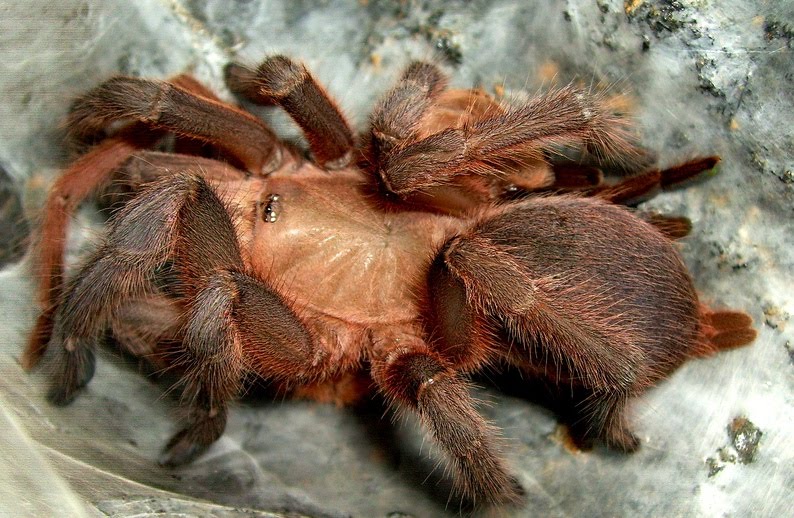
A common tarantula in the south Kerala characterized by bluish reflections on the thorax and pinkish reflections on the abdomen. It builds burrows on the road side mud banks. Recently reported Thrigmopoeus psychedelicus Sanap & Mirza 2014 is probably a synonym of this species.


Lyrognathus crotalus Pocock, 1895 Photo courtesy: earthtiger2 http://www.flickr.com/photos/earthtiger2/2874487276/in/photostream
Plesiophrictus species Photo courtesy: Mathew http://www.flickr.com/photos/32094518@N04/4269853149/in/photostream/.
Poecilotheria formosa Pocock, 1899:- P. formosa is endemic to the southern Eastern Ghats between Salem and Tirupathi in southern India. They are reported only from three locations: Renigunta in Andhra Pradesh; Kadiampatti, and Mullapuram in Salem District. Forests in these areas are of dry deciduous type with few patches of moist forests. P. formosa is the same species as P. nallamalaiensis; Poecilotheria nallamalaiensis Rao et al., 2006, is a junior synonym of Poecilotheria formosa Pocock, 1899. These are arboreal spiders that constructs their webs in dead tree stumps and broken off branches etc. The name Poecilotheria is derived from Greek "poikilos" - spotted and "therion" - wild beast. Pokie is a common name used for some of the species. This genus is known for vivid color patterns, fast movement, and potent venom compared to other tarantulas. The genus is native to Sri Lanka and India.

Poecilotheria metallica Pocock, 1899:- P. metallica is a colourful species that reflects brilliant metallic blue color. It was first discovered in a town in central southern India called Gooty. Hence, its common name is Gooty Sapphire Ornamental Tree Spider. The species is found in a single location in Andhra Pradesh: Reserve forest between Nandyal and Giddalur. Though the spider was first found in a railway timber yard in Gooty, its true habitat is about 15 miles to the north. In the wild the P. metallica lives in holes of tall trees where they make asymmetric funnel webs. Their primary prey consists of various flying insects, which they seize in flight and paralyze. It is not unknown for the spiders of this genus to live communally when territory, i.e. number of holes per tree, is limited. P. metallica is considered Critically Endangered by the IUCN Red List.
Poecilotheria regalis (Pocock, 1899)

The common name for this spider is Indian Ornamental Tree Spider, or simply Indian Ornamental. P. regalis is one of the most popular arboreal tarantulas. Their legspan sometimes exceeds 7 inches. The name Poecilotheria is derived from Greek "poikilos" - spotted and "therion" - wild beast. Regalis refers to "royal". The spider's natural habitat is primarily Southeastern India. In the wild the P. regalis live in holes of tall trees where they make asymmetric funnel webs. Their primary prey consists of various flying insects, which they seize in flight and paralyze. This is a very aggressive spider. 
Although there has never been a recorded death from any tarantula bite this species is considered to be a relatively dangerous spider, with venom that may cause intense pain, judging from the experience of keepers bitten by other spiders from this genus. They move rapidly and, although they generally prefer flight to fight, may attack when cornered. Sadly, the habitat of these and other "Pokies" is disappearing at an alarming rate, so much so that Indian Ornamentals may not exist in the wild unless urgent efforts are taken to prevent their habitat destruction.